Sunday Evening Reset: Set Your Caffeine Cut-Off and Start the Week Mindfully

Sunday evening has a quieter feeling. The week is almost complete, tomorrow is still ahead, and there is a little room to return to yourself.
Around 6:30 p.m., a full reset does not need to become another project. A few small choices can make the evening feel clearer. Notice how the week looked. Make space for rest. Choose one or two healthy daily habits that feel supportive for Monday.
Today’s focus is caffeine. Not as a warning. Not as a reason to feel guilty. Simply as something useful to notice.
More awareness. Less overwhelm.
1. Notice the week
Before planning the week ahead, take a gentle look back.
How did your caffeine intake move through the day? Was your first drink earlier than usual? Did an afternoon coffee become part of a busy routine? Did you choose tea, coffee, chocolate, or another source of caffeine later than you intended?
There is no perfect answer to find. The point is not to evaluate the week. It is to see the pattern, not the noise.
Caffeine may appear in familiar places, including coffee, tea, chocolate, energy drinks, some supplements, and certain over-the-counter medicines. The FDA recommends considering all sources when thinking about daily intake.
If you want a clearer picture, Nourish works as a simple caffeine intake tracker. Quick presets make it easier to log a drink while the detail is still fresh. Over time, the daily view can help you notice timing and routines without turning the evening into a spreadsheet.
Research on digital health tools suggests that information, self-monitoring, feedback, and goal setting may support short-term behavior change. A small pilot study on digital caffeine feedback found potential short-term benefits, while also noting the need for larger and longer studies. (Frontiers in Digital Health) A recent validated 24-hour caffeine recall method offers another structured way to measure intake. (PubMed)
Simple is more sustainable. A tracker should give you a place to return, not another task to carry.

2. Find your cut-off
A personal caffeine cut-off can be a calm way to create more space before bed.
Caffeine has an average half-life of about five hours in healthy adults. In other words, the body takes about five hours to reduce the amount of caffeine in the system by half. The usual range can be approximately two to ten hours, depending on factors such as genetics, smoking, pregnancy, and oral contraceptive use. (NCBI Bookshelf; NCBI StatPearls)
That does not mean everyone needs the same schedule. It means timing may be worth noticing.
Caffeine works partly by blocking adenosine receptors in the brain. Adenosine is involved in the feeling of sleep pressure, so this receptor activity can delay sleep onset and affect sleep efficiency. (NCBI StatPearls)
Sleep research also suggests that caffeine can affect rest even when it is consumed several hours before bedtime. In one study, caffeine taken six hours before bed reduced total sleep time. (Drake et al., 2013) A 2023 systematic review and meta-analysis found that a standard coffee serving of about 107 milligrams may need to be consumed at least 8.8 hours before bedtime to avoid reducing total sleep time. (Gardiner et al., 2023)
A 2024 randomized crossover trial found that a 400-milligram dose could disrupt sleep when taken within 12 hours of bedtime, with stronger effects closer to bedtime. The same trial found less disruption from a 100-milligram dose under its tested conditions. (Gardiner et al., 2024)
So, where might your cut-off fall?
Try working backward from your usual bedtime:
- For a 10:00 p.m. bedtime, begin with a cut-off between noon and 2:00 p.m.
- For a 10:30 p.m. bedtime, try 12:30 to 2:30 p.m.
- If you are more sensitive to caffeine or notice restless sleep, an earlier cut-off may feel more supportive.
- If your schedule changes, your cut-off can change too.
These are starting points, not rules. Notice what feels helpful over several days. There is no need to force a major change overnight.
For most adults, the FDA cites 400 milligrams per day as an amount not generally associated with negative effects. Individual sensitivity, medications, pregnancy, and health conditions can change what is appropriate, so the FDA recommends speaking with a healthcare professional when those factors apply. (FDA)
3. Create a softer evening
Once the last caffeinated drink has passed, the evening can become less about removing something and more about adding gentle cues for rest.
You might try:
- A caffeine-free herbal tea in a favorite mug.
- A glass of water while you prepare for the night.
- A 10- to 15-minute gentle walk after dinner.
- Dimmed lights in the rooms you use most.
- Calming music at a low volume.
- A phone placed face down or left in another room.
- A few quiet minutes without screens before bed.
None of this needs to be elaborate. Think of it as a transition. The day is closing, and your attention is allowed to become smaller.
A short walk can be logged in Nourish through the activity tracker, without step-counting pressure or a performance goal. The purpose is simply to notice movement that feels good and intentional.

A simple evening infusion
For a warm, caffeine-free option, try:
- 1 cup of hot water
- 1 herbal tea bag, such as chamomile or peppermint
- A small slice of fresh ginger, if desired
- A squeeze of lemon, if it suits you
Let it steep for a few minutes. Sip slowly while the lights are lower and the day becomes quieter.
4. Check in with water
Evening hydration can be easy to overlook, especially when the day has been busy.
A glass of water can be a simple pause. It can also give you a moment to notice what you actually need before reaching for a snack or another drink. No conclusion is required. Just a little more information.
Nourish’s water tracker app helps you log hydration in US customary units, using ounces. Quick-add buttons make the process light, and the daily view lets you see where you are without needing to remember every glass.
Hydration does not need to become an evening target to meet. It can simply be one more supportive detail in the wind-down.
5. Prepare without overhauling
Monday does not need a complete transformation.
A few small preparations may make the morning feel more familiar:
- Prepare one meal or snack for tomorrow.
- Place walking shoes somewhere easy to see.
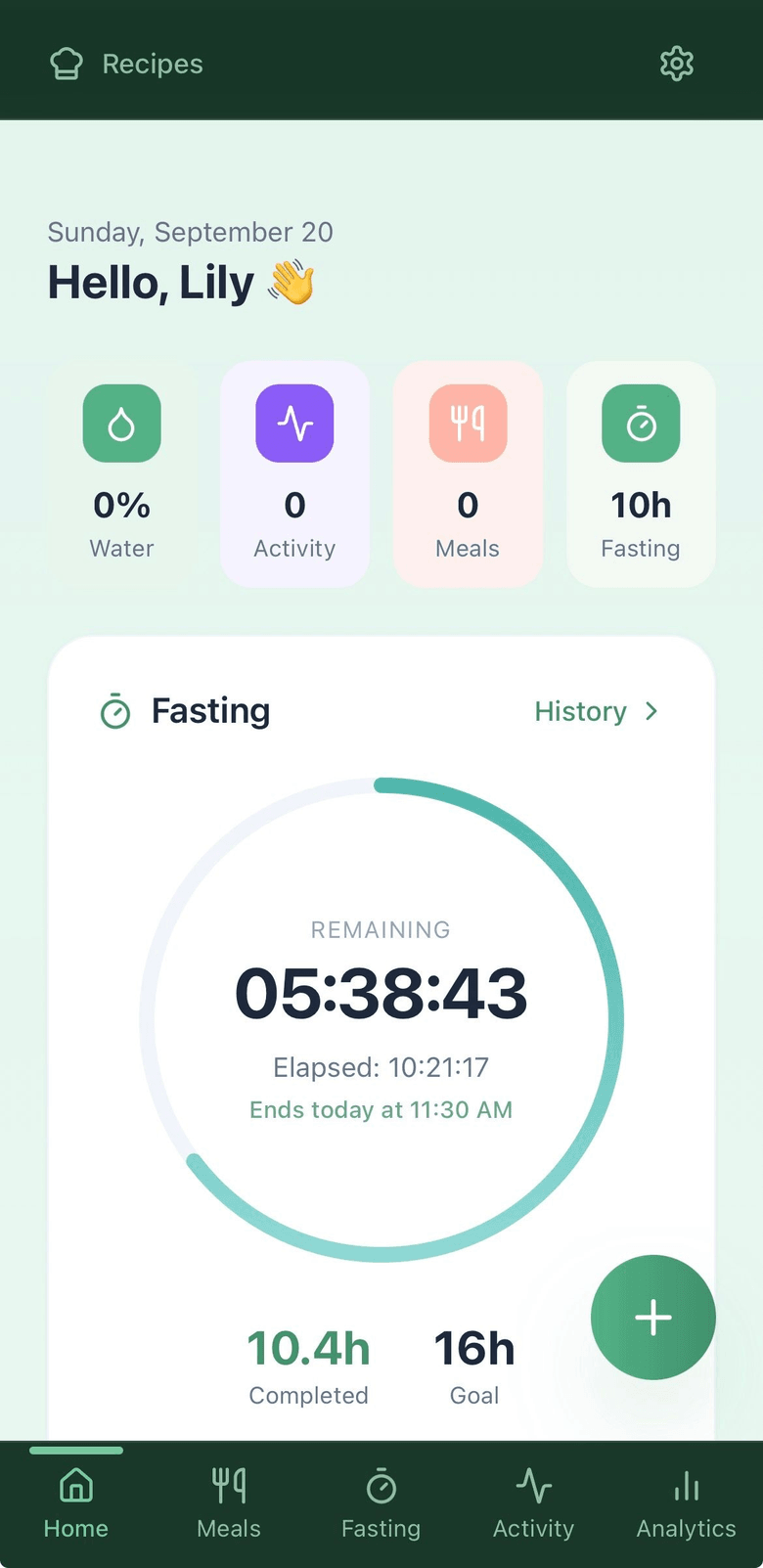
- Check tomorrow’s fasting window in the Nourish fasting timer.
- Choose one or two habits to focus on.
- Put a water bottle where you will notice it.
- Decide when you would like to begin winding down tomorrow night.
If you are exploring intermittent fasting for weight loss or reflecting on the potential intermittent fasting benefits that matter to you, flexibility still belongs in the process. Nourish lets you choose a 16:8, 18:6, 20:4, 5:2, or custom schedule. You can pause, edit, and revisit your plan as your life changes.
The timer is there to support awareness. It does not decide what your body or schedule needs.
6. Choose what comes with you
A habit tracker app can be useful when it feels like a place to land rather than a system to satisfy.
In Nourish, you can create a gentle wind-down routine with habits such as:
- Log caffeine before the afternoon cut-off.
- Drink water in ounces.
- Take a short walk.
- Dim the lights.
- Play calming music.
- Set the phone aside.
- Prepare tomorrow’s fasting window.
Drag and drop the habits into the order that feels natural. Check off what you want to remember. Leave room for changing days.
Streaks can offer a visual reminder of consistency, but they do not need to become a measure of worth. If a day looks different, you can begin again. Every evening is another opportunity to return.
Weekly insights can help you see patterns across caffeine, hydration, activity, meals, fasting, and habits. The goal is not to optimize every detail. It is to make the bigger picture easier to understand.
A fresh start for Monday
Tonight, you do not need a fix-it list.
You might simply choose a caffeine cut-off, fill a glass of water, take a gentle walk, and prepare one small thing for tomorrow. That is enough space to begin.
The week ahead can hold structure without rigidity. It can hold healthy daily habits without perfection. It can have a rhythm of its own.
Clear enough to return to. Gentle enough to keep.
Sources
- NCBI Bookshelf: Pharmacology of Caffeine
- NCBI StatPearls: Caffeine
- U.S. Food and Drug Administration: Spilling the Beans
- Drake et al., Caffeine effects on sleep taken 0, 3, or 6 hours before bed
- Gardiner et al., The effect of caffeine on subsequent sleep: systematic review and meta-analysis
- Gardiner et al., Dose and timing effects of caffeine on subsequent sleep
- Healthline: Can You Drink Coffee While Doing Intermittent Fasting?
- Frontiers in Digital Health: Digital caffeine feedback and short-term behavior change
- PubMed: Validated 24-hour Caffeine Intake Recall method
Nourish is a wellness tracking tool and is not intended to diagnose, treat, cure, or prevent any disease. Consult a qualified healthcare professional before starting any fasting or nutrition program, or if you have questions about caffeine, sleep, medications, pregnancy, or an existing health condition.